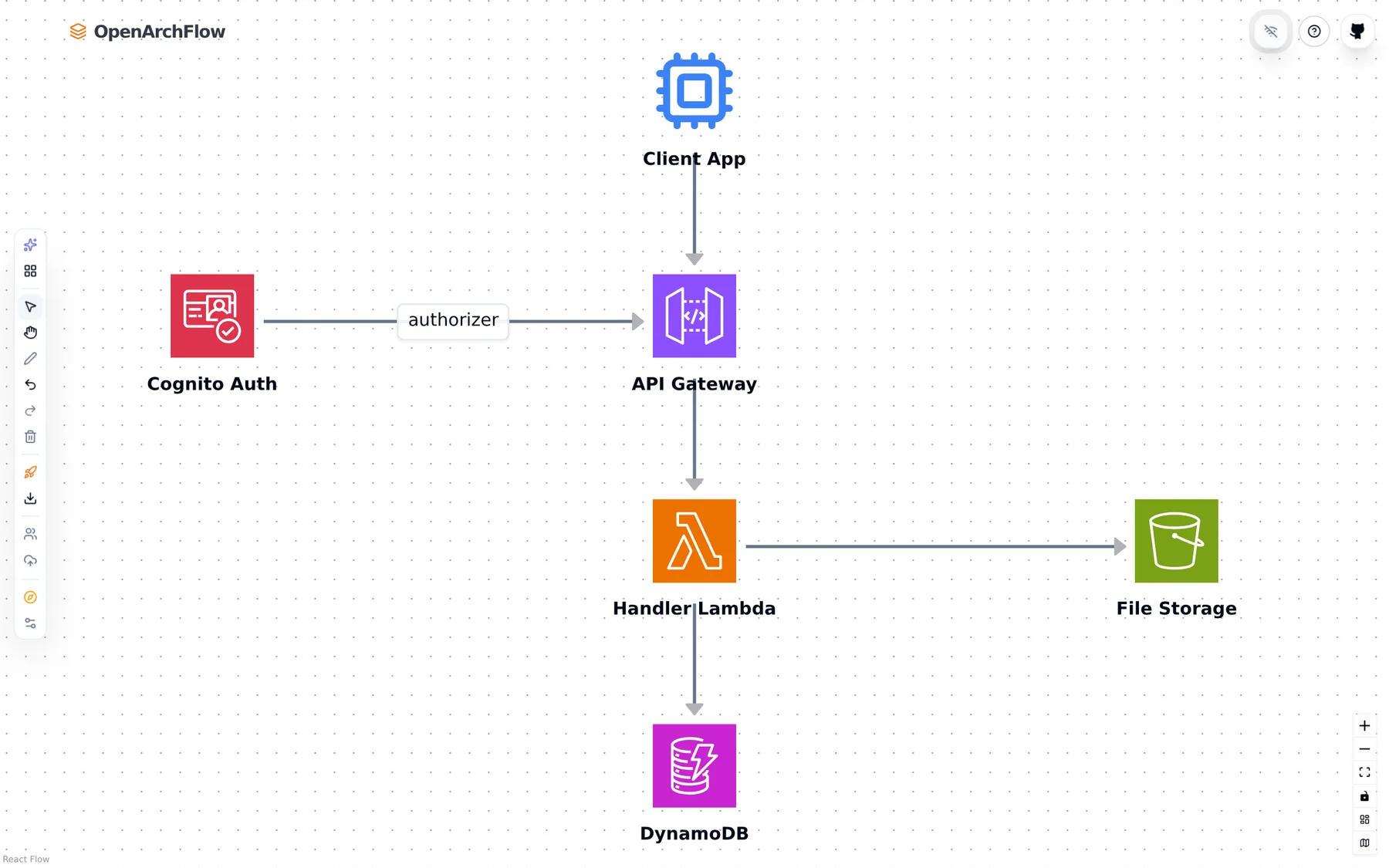
Serverless REST API
- Client
- API Gateway
- Lambda
- DynamoDB
Client → API Gateway → Lambda → DynamoDB. The classic pay-per-use backend: designed from one sentence, exported to Terraform and testable locally before you touch an AWS account.
Real screenshots from app.openarchflow.cloud, captured in November 2026: the canvas, templates, Terraform export, MiniStack deploy and Glue Studio.

The AWS Serverless API template on the canvas — Cognito, API Gateway, Lambda, DynamoDB and S3 with labeled connections you can drag, edit and auto-layout.
From natural language to Terraform and a running local environment, in minutes.
Multi-provider AI engine supporting Gemini 2.0/2.5, AWS Bedrock, and local WebLLM. Describe infrastructure in plain English and refine with follow-up chat.
Export any diagram to Terraform HCL (main.tf, variables.tf, outputs.tf). Dependencies are inferred from your diagram edges across 50+ AWS resource types.
Deploy to MiniStack and get interactive consoles for S3, Lambda, DynamoDB, SQS, SNS and more — including native AWS Glue jobs. Test locally at zero cloud cost.
Peer-to-peer over WebRTC with end-to-end encryption — the key stays in the URL fragment. Optionally back up your diagrams to Google Drive.
Import live resources from 24 AWS services. Connections are inferred from ARN references, rendering your real infrastructure as an editable diagram.
Cost estimates from the AWS Price List API, with a per-architecture bill of materials you can export to CSV.
Describe one in plain English, refine it on the canvas, export Terraform — and deploy it locally when MiniStack supports the services.
Client → API Gateway → Lambda → DynamoDB. The classic pay-per-use backend: designed from one sentence, exported to Terraform and testable locally before you touch an AWS account.
EventBridge routes events to an SNS topic that fans out to SQS queues consumed by Lambda workers. Deploy it to MiniStack and publish from the consoles to watch messages flow.
Producers write to a Kinesis stream; Lambda processes batches, stores raw events in S3 and keeps aggregates in DynamoDB.
Land raw files in S3, catalog them with Glue, transform with a PySpark job into a curated bucket and query with Athena. With MiniStack the PySpark job runs for real in a local Glue container — no AWS account, no cost.
Route 53 and CloudFront in front of an ALB, containers on ECS Fargate, RDS for persistence and ElastiCache for sessions, inside a VPC with public and private subnets. Ideal for design reviews, Terraform scaffolding and cost estimates.
Scan a live account, import 24 supported services as an editable diagram with connections inferred from ARNs, then export it to Terraform to start bringing legacy infrastructure under IaC.
MiniStack is a free, open-source AWS emulator that starts in about two seconds. Deploy your diagram with one click, then use per-resource consoles: browse S3 buckets, invoke Lambda functions, scan DynamoDB tables, send SQS messages and test API Gateway routes — all on your machine.
Start MiniStack:
docker run -p 4566:4566 ministackorg/ministack4 resources deployed · 0 errors
MiniStack executes Glue jobs for real, inside a Docker container built on the official AWS Glue 4.0 libraries. OpenArchFlow adds Glue Studio on top: browse the catalog, edit PySpark, start runs, stream Spark logs live and query results with Athena SQL.
Explore the databases and tables of your deployed Glue Catalog.
Edit PySpark scripts and start job runs from the Runs tab.
Toggle Live to stream JVM and Spark logs, forwarded to local CloudWatch Logs.
Run SQL over real S3 files with DuckDB — requires the ministackorg/ministack:full image.
What you need
With Docker Compose:
docker compose -f docker-compose.ministack-aws-glue-full.yml up -dOr with docker run:
docker run -d -p 4566:4566 -v /var/run/docker.sock:/var/run/docker.sock -e GLUE_DOCKER_IMAGE=ghcr.io/dmux/openarchflow/ministack_glue_libs_4.0.0_image_01:latest -e S3_PERSIST=1 ministackorg/ministack:full